E20 Petrol in India Explained: Mileage Impact, Older Cars, Warranty and What Is Disputed
ShortsWatch while you're here
All Shorts → ShortMaruti is LOSING! 🚨 Tata Punch Becomes India's No.1 SUV! 🤯 #shorts
 ShortNexon In DANGER! 🚨 Hyundai Bayon Gets 5-STAR Safety & Level 2 ADAS! 🤯 #Shorts
 ShortNexon is DEAD! 🚨 Skoda Kylaq Gets ₹90,000 DIWALI Discount! 🤯 #Shorts
 ShortCreta Ka Kalesh! 🚨 Hyundai Bayon Real Images Leaked & Tech Revealed! 🤯 #Shorts
 ShortTesla's Flying Car Isn't For Sale! 🚨 The Genius Decoy Effect Explained! 🤯 #Shorts
 Short0-100 IN 0.59 SECONDS?! 🚨 New Tesla Roadster Gets FLYING ROCKET Thrusters! 🤯 #Shorts
 Shorti20 is DEAD! 🚨 New Toyota Glanza Launched at ₹6.99 Lakh with LEVEL 2 ADAS! 🤯 #shorts
 ShortNexon is DEAD! 🚨 Mahindra XUV 3XO Gets TWIN-CYLINDER CNG! 🤯 #Shorts
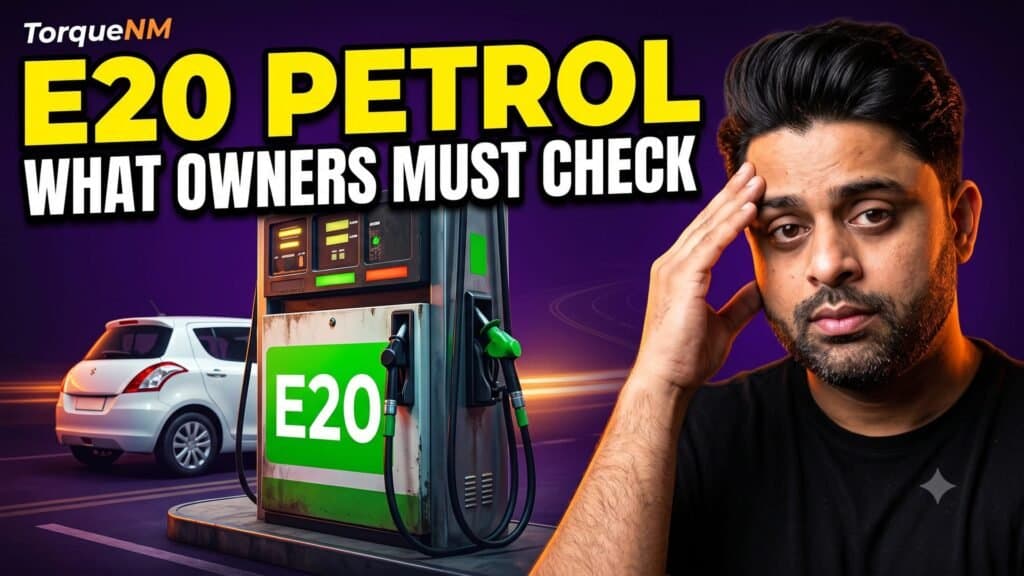
E20 petrol is now the standard petrol grade in India, and the government says it has no plan to bring back plain E10 at the pump, so most owners cannot avoid it. The notification of 17 February 2026 made E20 with a minimum octane rating of 95 the mandatory petrol grade from 1 April 2026. Our video, titled as if E20 had ended people’s freedom, was far more dramatic than the facts: it is a legal mandate, the Supreme Court declined to interfere, and the real issues are mileage, older cars, choice and fuel quality. This guide explains what E20 petrol is, what the evidence says about mileage and warranty, what is disputed, and what older-car owners should check.

Watch the full video above for the original discussion. The written version below separates what is confirmed, what is disputed and what is undecided, as of October 2026.
What the video covers
- What E20 petrol is and why it was introduced.
- Fuel quality concerns and the claims about contaminated samples.
- What the government and the industry have said.
E20 petrol at a glance
- What it is: petrol with up to 20 percent ethanol. The first E20 outlets opened in February 2023.
- Mandatory since: 1 April 2026, with a minimum octane rating of 95, per a 17 February 2026 notification reported by Business Standard. Exemptions for specific regions or periods are possible.
- E10: the Lok Sabha was told in July 2026 that there is no proposal to revert to E0 or E10.
- Mileage: the government and ARAI say a loss of about 2 to 6 percent.
- Ethanol-free petrol: available only as premium 100-octane grades.
Can you still buy ethanol-free petrol?
Yes, but only at a premium. Grades such as XP100, Power100 and Speed100 are ethanol-free, and an RTI reply from Indian Oil confirmed that XP100 has no ethanol. They sell at roughly ₹160 to ₹167 a litre against about ₹102 to ₹111 for regular petrol, at fewer than one percent of pumps and mostly in metros. XP95 and Speed97 are not ethanol-free. There is an open question: in August 2026 the Chief Economic Adviser suggested keeping a lower blend for older cars, and the ministry and the oil companies were reportedly discussing E10 in the 95-octane grade. BPCL said this does not mean E20 is going out, and we found no decision.
Is E20 safe for your car?
Vehicles made from 1 April 2023 are designed for E20 under the second phase of BS6. For older cars the makers do not agree. Honda says all its India-made cars from 1 January 2009 are material-compatible. Maruti says E20 is fine even for older E10-certified cars. Toyota’s manual lists E10, but the company says pre-April-2023 cars can use E20 and warns of premature wear. Mahindra says pre-2025 models are “safe to operate” but not specially designed for it. Volkswagen says pre-April-2020 components were not evaluated for E20. One luxury maker’s claim that all BS6 cars are compatible is contradicted by some owner’s manuals. So the right source is your own car’s manual and dealer, not a general statement.
Mileage: what the evidence says
Business Today’s report on ARAI’s findings puts the loss at 2 to 6 percent. The ministry has framed it as 1 to 2 percent for E20-calibrated vehicles and 3 to 6 percent for older ones. ARAI, SIAM and Indian Oil tested BS3, BS4 and BS6 vehicles in the lab and on the road, covering 40,000 km for cars and 20,000 km for two-wheelers, and reported no failures. ARAI also says some older rubber hoses, seals and gaskets in non-E20 vehicles may wear faster. We found no published independent lab test. Some owners report drops above 10 percent, but those reports are anecdotal and unverified.
Warranty and insurance
SIAM, Mahindra, Honda, Tata and Hyundai say warranties are honoured on E20, and Autocar India reported that warranties remain valid on E20 according to the government and an industry panel. SIAM’s chief said insurance claims are unaffected. We found no statement from the insurance regulator or the insurers guaranteeing payouts for E20-related damage, so get your dealer’s and insurer’s position in writing if you drive an older car.
The contamination claims: disputed
This is the most contested part. A report by Reuters, carried by Autocar India, said Maruti, Tata and Mahindra internal tests of more than 250 samples from 21 states and union territories found high chloride in 18 of them, with moisture up to 13,000 ppm against a 3,000 ppm limit and chloride up to 570 ppm against a 3 ppm limit. The ministry said on 8 August that claims of 500 ppm chloride and moisture were “not validated”, citing oil-company tests of 0 to 3 ppm, and the oil companies rejected the claims after nationwide testing. Mahindra called its executive’s conclusions baseless, and SIAM withdrew its communication on the issue, calling its data insufficient. So contamination is unproven either way, and these were the makers’ internal tests, not independent ones.
Courts, rules and what comes next
The Supreme Court, in a bench led by the then Chief Justice Gavai, dismissed a petition seeking an ethanol-free option on 1 September 2025, saying it was not inclined to entertain it. That was a summary dismissal with no ruling on consumer choice. Beyond E20, the government says no decision has been taken, and reports of E22 to E30 specifications and dates are unverified. Blending isobutanol into diesel is planned but not notified.
| Point | Status |
|---|---|
| E20 as the standard grade | Mandatory from 1 April 2026 |
| Return of E10 | No proposal; talk of E10 in 95-octane petrol, undecided |
| Mileage loss | 2 to 6 percent per ARAI; no independent test found |
| Warranty | Makers say honoured; insurers’ position not found |
| Fuel contamination | Disputed; makers’ internal tests vs ministry |
| E27 or E30 | No decision found |
What older-car owners should check
- The owner’s manual, and the dealer’s written E20 statement for your model and year.
- Your warranty status, and keep fuel receipts and service records.
- Your insurer’s written position on fuel-related damage.
- Rubber fuel hoses, seals, gaskets, and the fuel pump and injectors, especially on 2005 to 2016 cars.
- Cars parked for weeks: ethanol absorbs moisture, so avoid long storage on a part-full tank.
- Fill at busy, trusted outlets, and report water or contamination to the oil company’s helpline.
- Log your mileage per tank before and after, for a fair comparison.
- An ethanol-free premium grade is an option but costs about 50 percent more.
A note on our video
Our video’s title said E20 had ended “our independence”, which the facts do not support. The description’s claim about contaminated samples is imprecise: the Reuters report cited more than 250 samples from 21 states and union territories, with high chloride in 18, and the whole matter is disputed. The government’s “no plan to restore E10” line is no longer the full story after the August discussion of E10 in 95-octane petrol. We found no independent mileage test, and we have not tested E20 ourselves. This is an explainer and not mechanical or legal advice.
What should you do?
If your car was built after April 2023, use E20 as normal. If it is older, check the manual, ask the dealer in writing and watch the rubber parts. Watch the full video for the discussion, and see the videos page and car news. For the warranty position, see Autocar India’s report.
E20 petrol FAQs
Is E20 petrol mandatory in India?
Yes. A notification of 17 February 2026 made E20 with a minimum octane rating of 95 the mandatory petrol grade from 1 April 2026, with exemptions possible for specific regions or periods.
Does E20 petrol reduce mileage?
ARAI and the government say a loss of about 2 to 6 percent. We found no independent test, and some owners report larger drops, which are unverified.
Can I use E20 petrol in an old car?
Makers disagree. Vehicles built from April 2023 are designed for it, while for older cars you should check the owner’s manual and get the dealer’s position in writing.
Is ethanol-free petrol available?
Only as premium 100-octane grades such as XP100, at about ₹160 to ₹167 a litre, at fewer than one percent of pumps.
Does E20 petrol void my car’s warranty?
Makers including Mahindra, Honda, Tata and Hyundai say warranties are honoured on E20. Ask your dealer to confirm it in writing for your car.
E20 petrol is the legal default, so check your car’s manual, keep your records and watch the rubber parts if your car is older.
Hindi car news on YouTube
Spy shots, launch dates & variant breakdowns
New Shorts most days and full comparison videos every week. Subscribe so the next launch reaches you first.
60-second car news
Watch next
ShortMaruti is LOSING! 🚨 Tata Punch Becomes India's No.1 SUV! 🤯 #shortsShortNexon In DANGER! 🚨 Hyundai Bayon Gets 5-STAR Safety & Level 2 ADAS! 🤯 #ShortsShortNexon is DEAD! 🚨 Skoda Kylaq Gets ₹90,000 DIWALI Discount! 🤯 #ShortsShortCreta Ka Kalesh! 🚨 Hyundai Bayon Real Images Leaked & Tech Revealed! 🤯 #ShortsShortTesla's Flying Car Isn't For Sale! 🚨 The Genius Decoy Effect Explained! 🤯 #ShortsShort0-100 IN 0.59 SECONDS?! 🚨 New Tesla Roadster Gets FLYING ROCKET Thrusters! 🤯 #ShortsShorti20 is DEAD! 🚨 New Toyota Glanza Launched at ₹6.99 Lakh with LEVEL 2 ADAS! 🤯 #shortsShortNexon is DEAD! 🚨 Mahindra XUV 3XO Gets TWIN-CYLINDER CNG! 🤯 #Shorts ShortTATA SAVES JEEP! 🚨 New Jeep SUV Based on Tata Sierra Platform Confirmed! 🤯 #shorts
 Short7 NEW CARS Launching This Week! 🚨 Duster Hybrid, Audi Q3, 3XO CNG & More! 🤯 #Shorts
Comments
Loading comments...