India V2V System Explained: Draft Rule, 2028 Target and What It Means for Car Owners
ShortsWatch while you're here
All Shorts → ShortMaruti is LOSING! 🚨 Tata Punch Becomes India's No.1 SUV! 🤯 #shorts
 ShortNexon In DANGER! 🚨 Hyundai Bayon Gets 5-STAR Safety & Level 2 ADAS! 🤯 #Shorts
 ShortNexon is DEAD! 🚨 Skoda Kylaq Gets ₹90,000 DIWALI Discount! 🤯 #Shorts
 ShortCreta Ka Kalesh! 🚨 Hyundai Bayon Real Images Leaked & Tech Revealed! 🤯 #Shorts
 ShortTesla's Flying Car Isn't For Sale! 🚨 The Genius Decoy Effect Explained! 🤯 #Shorts
 Short0-100 IN 0.59 SECONDS?! 🚨 New Tesla Roadster Gets FLYING ROCKET Thrusters! 🤯 #Shorts
 Shorti20 is DEAD! 🚨 New Toyota Glanza Launched at ₹6.99 Lakh with LEVEL 2 ADAS! 🤯 #shorts
 ShortNexon is DEAD! 🚨 Mahindra XUV 3XO Gets TWIN-CYLINDER CNG! 🤯 #Shorts
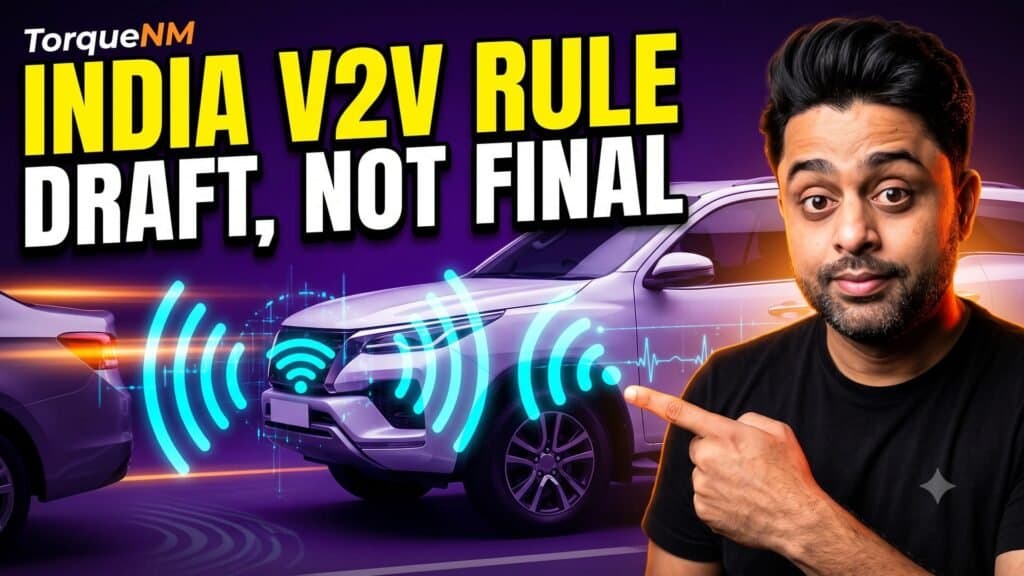
The India V2V system is a draft rule and not yet a law: in early August 2026 the Ministry of Road Transport and Highways proposed that new vehicles carry vehicle-to-vehicle communication hardware from 1 October 2028, with an optional stage from 1 October 2027. Our video called it a “new government rule”, which overstates it, because nothing is mandatory today and the proposal could still change. This page is the written companion to the video. It explains what the draft says, how V2V works, what has been settled on spectrum, the cost and privacy questions that remain open, and what it means if you already own a car.

Watch the full video above for the walkthrough in Hinglish. Below is the checked version, with the status as of October 2026.
What the video covers
- What the proposed V2V framework is and how vehicles would talk to each other.
- The 5.9 GHz spectrum and the use cases such as emergency braking and wrong-way alerts.
- The safety case, and the questions on privacy, tracking, false warnings and older cars.
India V2V system at a glance
- What it is: a draft amendment to the Central Motor Vehicles Rules, 1989, issued around 3 August 2026.
- Standard: AIS-230, for factory-fitted on-board units using C-V2X in the 5.9 GHz band.
- Who it covers: categories L, M and N, which means two- and three-wheelers, cars, buses and goods vehicles.
- Proposed dates: 1 October 2027 for vehicles that are fitted with V2V, and 1 October 2028 for all newly made vehicles.
- Status: still a draft. We found no final notification.
What the draft says
According to Autocar India’s report on the draft and the ministry’s press release, the proposal relies on AIS-230, which the vehicle-standards committee considered at its 56th meeting on 7 May 2026. From 1 October 2027, vehicles in the covered categories that are fitted with V2V would have to comply with AIS-230, which means fitment is still optional at that stage. From 1 October 2028, every newly manufactured vehicle in the covered categories would have to carry a compliant system. That is “mandatory” only if the draft is finalised as written. No retrofit deadline has been announced, so vehicles already on the road fall outside the draft.
How the India V2V system works
Vehicles with an on-board unit broadcast their speed, position, direction and acceleration to nearby vehicles, which lets each car know about a hard-braking vehicle ahead or a vehicle approaching the wrong way. The draft names four warning applications to be introduced in phases: emergency brake alert, forward collision warning, wrong-way driving alert and emergency vehicle alert. These are warnings, not vehicle control, and the ministry says V2V is expected to complement ADAS. AIS-230 sets minimum requirements for radio performance, receiver sensitivity, satellite positioning, power supply, interference, cybersecurity and application performance. A consultation paper from the telecom regulator reportedly favoured C-V2X over the older DSRC technology. We found no official range or response-time figures.
Spectrum: what is settled
This is the one part already final. The Department of Telecommunications issued G.S.R. 466(E) on 10 June 2026, which exempts on-board units from licensing. It does not cover roadside units. Reports describe the exempted band as 5,875 to 5,905 MHz, with limits on power and conditions of non-interference, and the ministry’s release describes 5.875 to 5.925 GHz, so the exact edge of the band is unclear without the gazette text. The telecom regulator’s consultation paper separately proposes keeping 5,905 to 5,925 MHz for future intelligent transport use, and had not issued recommendations as of mid-September.
Cost, privacy and the open questions
| Question | What we found |
|---|---|
| Cost to owners | The draft does not address it. Autocar India cites earlier estimates of about ₹5,000 to ₹7,000 per vehicle, which is an estimate and not an official figure |
| Security | AIS-230 includes cybersecurity and communication-security requirements, but we could not verify the specific mechanisms |
| Privacy and tracking | The regulator’s paper flags spoofing, replay attacks and surveillance risks from continuous broadcasts, and notes India has no V2X-specific privacy framework. These are concerns and recommendations, not adopted rules |
| Older cars | No retrofit mandate found |
| False warnings and interference | No official source found |
Do not read more into the draft than it says. We found no confirmed requirement for a national security certificate system, and an earlier claim that AIS-230 mandates one was corrected by a regulatory tracker. The privacy and tracking worries in our video are real concerns raised by commentators and the regulator, but we cannot say the rule has or lacks specific protections.
Why the government wants it
The safety case rests on India’s road deaths. The ministry’s report on road accidents in 2024 records 4,87,707 accidents and 1,77,175 deaths, as reported in summaries of the report, and a provisional lower figure also circulated, while crime-records data differ. V2V warnings aim to give drivers a few extra seconds before a crash that cameras and radar cannot see, such as a vehicle hidden around a bend. They only work if both vehicles carry the system, so the benefit grows slowly as new cars replace old ones.
What happens next for the India V2V system
The 30-day comment period ran from 3 August and closed around early September. One trade report said the norms were expected to be notified by December 2026, but we did not verify it, and a final notification in the last few weeks cannot be ruled out. Before you rely on any date, check the ministry’s website and the gazette. The ministry’s release is on PIB, and a useful regulatory tracker is the Ambimat India V2X page, which is a secondary source.
A note on our video
Our video’s title said “New Government Rule”. It is a draft, and not in force. The description’s other points hold up: the framework is based on AIS-230 and C-V2X, vehicles exchange speed, location and direction, the band is around 5.9 GHz, and the use cases are emergency braking, collision warnings, wrong-way alerts and emergency-vehicle alerts. The accident figures match the ministry’s final 2024 report. The description also carried stray source labels that do not belong. The video’s remarks on privacy, tracking, false warnings, interference and old cars are discussion points, and we could not verify any of them in the draft text. We have not read the draft notification or the AIS-230 text, because neither is published where we could open it.
What should you do?
Nothing, for now. If you are buying a car in 2026, V2V will not be in it, and the draft does not require old cars to change. If you are following the rule, watch for the final notification, any cost figure and any privacy safeguards. Watch the full video for our discussion, and see the videos page and car news.
India V2V system FAQs
Is V2V mandatory in India?
Not yet. It is a draft proposed in August 2026, under which new vehicles would need it from 1 October 2028 if the draft is finalised.
What is V2V communication?
Vehicles broadcast their speed, position, direction and acceleration to each other so that a car can warn its driver of a braking vehicle ahead or a vehicle coming the wrong way.
Will my old car need V2V?
The draft has no retrofit requirement, so cars already on the road are outside it.
How much will V2V cost?
The draft gives no cost. Autocar India cites earlier estimates of about ₹5,000 to ₹7,000 per vehicle, which is not an official figure.
Does V2V track my car?
Vehicles broadcast position and speed, and the telecom regulator has flagged surveillance and privacy risks and the lack of a V2X privacy framework. No adopted rule on this has been found.
India’s V2V system is a draft with a 2028 target, so treat it as a proposal to watch and not a rule that changes what you drive today.
Hindi car news on YouTube
Spy shots, launch dates & variant breakdowns
New Shorts most days and full comparison videos every week. Subscribe so the next launch reaches you first.
60-second car news
Watch next
ShortMaruti is LOSING! 🚨 Tata Punch Becomes India's No.1 SUV! 🤯 #shortsShortNexon In DANGER! 🚨 Hyundai Bayon Gets 5-STAR Safety & Level 2 ADAS! 🤯 #ShortsShortNexon is DEAD! 🚨 Skoda Kylaq Gets ₹90,000 DIWALI Discount! 🤯 #ShortsShortCreta Ka Kalesh! 🚨 Hyundai Bayon Real Images Leaked & Tech Revealed! 🤯 #ShortsShortTesla's Flying Car Isn't For Sale! 🚨 The Genius Decoy Effect Explained! 🤯 #ShortsShort0-100 IN 0.59 SECONDS?! 🚨 New Tesla Roadster Gets FLYING ROCKET Thrusters! 🤯 #ShortsShorti20 is DEAD! 🚨 New Toyota Glanza Launched at ₹6.99 Lakh with LEVEL 2 ADAS! 🤯 #shortsShortNexon is DEAD! 🚨 Mahindra XUV 3XO Gets TWIN-CYLINDER CNG! 🤯 #Shorts ShortTATA SAVES JEEP! 🚨 New Jeep SUV Based on Tata Sierra Platform Confirmed! 🤯 #shorts
 Short7 NEW CARS Launching This Week! 🚨 Duster Hybrid, Audi Q3, 3XO CNG & More! 🤯 #Shorts
Comments
Loading comments...